
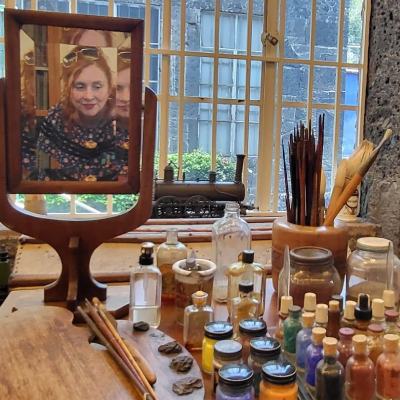
Red’s Mini Documentary
About Red
I decided to be an artist when I was about two years old and make art most days. I love working in mixed media, my favourite being water mixable oils with collage. I am based in Cornwall and have exhibited in London, Yorkshire, Cornwall, Cambridgeshire and Mexico City. I have been teaching art for 25 years.
I have been developing a collection of paintings called “We Learnt to Fly” over the last decade.These paintings have documented my recovery from domestic abuse and led to Arts Council England funding to travel to and work in Mexico City; the home of my heroine Frida Kahlo.
Domestic abuse and family court trauma has aftershocks in the body and brain, but this doesn’t have to hold survivors back. I hope that my imagery will inspire other women to know they can achieve anything and that however hard things get as a result of trauma and stigmatisation, everyone has value.
Red’s TEDx Talk
About Betty
Betty arrived in 2019, uninvited, unexpected and with quite a lot to say.
Betty is the name I have given to an involuntary voice that emerges through my speech as part of a neurological condition known as Functional Neurological Disorder (FND). She has her own accent, her own vocabulary and, apparently, very little interest in social convention. She is frequently outrageous, often hilarious, sometimes deeply uncomfortable and almost entirely beyond my control.
Betty can interrupt conversations, replace the words I intend to say, or take over my speech altogether. I remain conscious and aware throughout, but what comes out of my mouth is not necessarily what I intended. Sometimes I can anticipate her arrival; more often, I discover what she has to say at precisely the same moment as everyone else.
As an artist, I have become fascinated by the relationship between Betty and myself. Who is speaking when speech is involuntary? Where does intention end and expression begin? What happens to authorship, identity and agency when the body produces language independently of conscious thought?
Rather than attempting to silence Betty, I have begun to explore her through painting, collage, automatic writing, drawing and sound. Her often obscene and socially unacceptable language sits alongside familiar domestic imagery, creating unexpected encounters between respectability and disruption, control and spontaneity.
There is humour in this work, but also vulnerability. Betty can be liberating, embarrassing, exhausting and, at times, frightening. She challenges not only my understanding of myself but also the assumptions others make about neurological difference, behaviour and the boundaries of acceptable expression.
Red and Betty Said is an evolving body of artistic research into involuntary speech, identity, agency and the unconscious. It asks whether experiences that resist conventional language might find meaning through visual expression, and whether art can communicate something that clinical descriptions alone cannot.
Betty may not always say what I want her to say. But she has certainly given me something to think about. You can visit Betty’s Gallery to see more of her illustrated outbursts.
